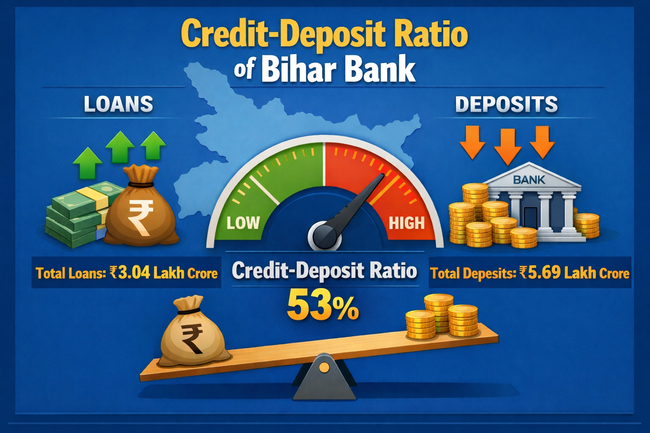
Patna: Bihar may be clocking one of the highest growth rates in the country, but a key banking indicator suggests the state’s financial system is not keeping pace with its economic ambitions.
The Bihar Economic Survey 2025–26, tabled in the Legislative Assembly on February 2, reported that the state registered an impressive 13.1 per cent growth in 2024–25, well above the national average of 9.8 per cent. Yet, the survey also revealed that Bihar’s credit-deposit (CD) ratio stands at just 53.5 per cent, among the lowest in the country.
As of March 31, 2025, banks operating in Bihar held deposits worth ₹5.69 lakh crore, but had extended loans of only ₹3.04 lakh crore within the state. In simple terms, for every ₹100 deposited, barely ₹54 is lent locally, with the remaining funds flowing out to other states.
In contrast, the national CD ratio is around 80 per cent, indicating a much stronger alignment between deposits and credit deployment across India.
Several economically stronger states report significantly higher ratios.
Maharashtra has a CD ratio close to 95–100 per cent.
Tamil Nadu and Telangana report ratios above 100 per cent, reflecting robust lending and industrial activity.
Gujarat and Karnataka maintain ratios in the 70–80 per cent range.
Even Uttar Pradesh records a CD ratio of around 60 per cent, higher than Bihar’s.
A low CD ratio generally signals limited credit absorption capacity, weak industrialisation, cautious lending practices, or structural bottlenecks in business growth. Analysts say Bihar’s case reflects a mix of these factors, including low industrial investment and higher perceived lending risks.
The gap is particularly significant as the Nitish Kumar government seeks to promote entrepreneurship, expand MSMEs and generate employment. Without stronger credit flow, especially to small businesses and agriculture, sustaining investment-led growth could prove difficult.
While Bihar has made strides in deposit mobilisation through financial inclusion and welfare schemes, the challenge now lies in ensuring that local savings are reinvested within the state.
The Economic Survey thus underscores a critical paradox: Bihar is growing fast, but much of its money is not.

