Patna, April 12 (BiharTimes):
In a landmark achievement for Bihar's scientific community, the Nanotechnology Centre at Aryabhatta Knowledge University (AKU) has been granted a patent by the Government of India for a novel yttrium-based semiconductor nanomaterial that could redefine the future of LED lighting and optoelectronics.
 The innovation, developed by a team led by Dr. Bibhuti Bikramaditya—Doctoral Scholar at AKU and Director of Smartway Electronics Pvt. Ltd.—along with Dr. Rakesh Kumar Singh, Prof. R. K. Verma of Munger University, and Mr. Nishant Kumar, represents a significant step toward energy-efficient and safer lighting technologies.
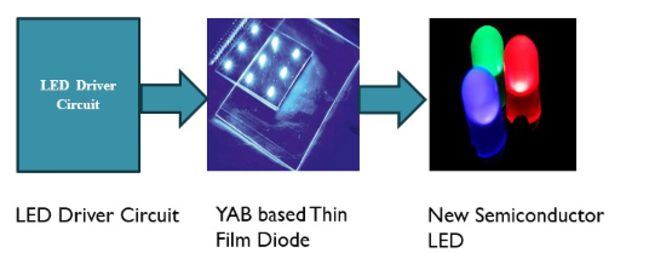
At the core of the invention is Yttrium Aluminium Borate (YAB), a nanomaterial synthesized through a cost-effective chemical method. The material demonstrates strong semiconductor characteristics at the nanoscale, including an energy band gap of 1.28–1.33 eV, making it suitable for advanced electronic and optoelectronic applications. Researchers found that LEDs coated with YAB nanoparticles deliver higher luminous efficiency, improved color quality, better thermal stability, and a longer operational life.
 What sets this development apart is its ability to overcome key limitations of existing LED technologies. Conventional LEDs rely on indium gallium nitride chips combined with cerium-doped phosphors, which often produce bluish-white light with low color rendering and contain rare-earth elements largely sourced from China. In contrast, the YAB-based material is lanthanide-free and can be sourced more sustainably, including from within India, thereby reducing import dependency.
The new LEDs are also designed to eliminate the “sparkling effect” commonly associated with current lighting systems, which can cause visual discomfort and potential retinal stress. With a higher color rendering index, the technology promises more natural and comfortable illumination. Additionally, the material enables both UV and visible LEDs to operate at significantly lower power levels—around 1.7 volts compared to the typical 3.5 volts—marking a major leap in energy efficiency.
Dr. Bikramaditya, who previously worked in semiconductor companies in South Korea before returning to India, pursued this research during his Ph.D. at AKU under the guidance of Dr. Singh and Prof. Verma. He noted that the patent process took nearly three years, reflecting the rigor and novelty of the work.
The project has already moved into the prototyping stage, with development underway at Smartway Electronics under incubation at Indian Institute of Technology Patna. Thin-film fabrication has been carried out in collaboration with the institute's Department of Physics, led by Prof. Manoranjan Kar. The initiative has also attracted interest from the Indian Institute of Science Bangalore for further research support, while testing collaborations are being explored with the Centre for Materials for Electronics Technology.
AKU Vice Chancellor Prof. Sharad Kumar Yadav congratulated the research team, stating that the patent highlights the university's growing strength in cutting-edge research and innovation. He also acknowledged the role of the Bihar government in fostering a supportive ecosystem for scientific advancement.
With proof-of-concept validation and scaling efforts ahead, the researchers believe that large-scale manufacturing of this indigenous LED technology could open new industrial avenues. The innovation not only strengthens India's semiconductor ecosystem but also positions Bihar as a rising center for nanotechnology-driven breakthroughs with global relevance.

